



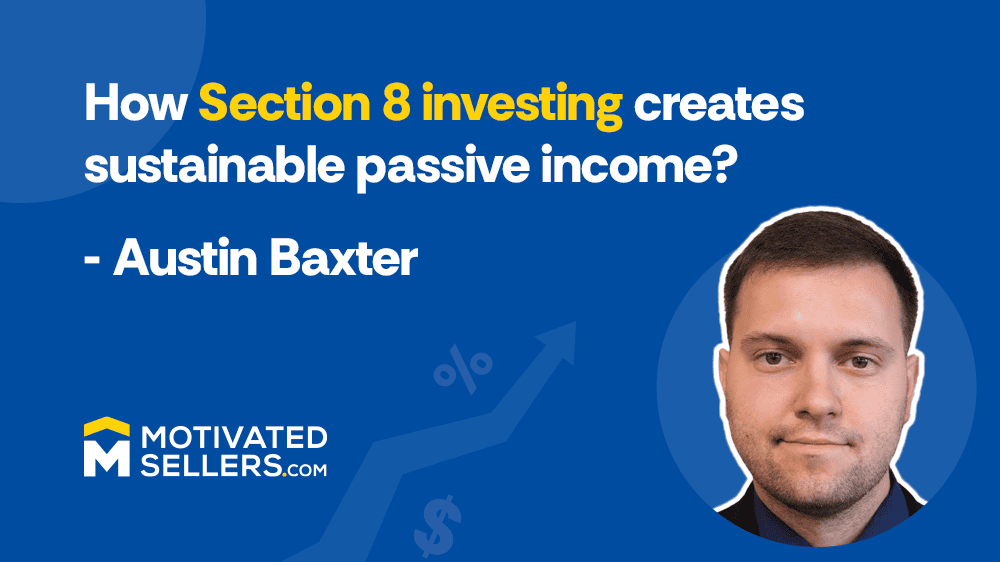
Austin Baxter found financial freedom through Section 8 investing. Austin Baxter focuses on the BRRRR method. Combined with Section 8 investing, this approach generates $300-$800 monthly positive cash flow from each property. The best part is that this cash flow is achieved without leaving personal capital in the deal. Today, Austin Baxter is building a nationwide portfolio of cash-flowing properties while coaching other investors to avoid the mistakes he encountered along the way.
Here are some points we discussed in this blog:
Austin Baxter worked for every trade including automotive, electrical, and even for the Department of Transportation. At one point, he was juggling two to three W-2 jobs plus a side business which left him exhausted.
"I had to find a way to get out of that," Austin explains. "I thought the stock market was going to be a good answer and it helped. It let me quit at least one of those jobs, but it wasn't enough to replace them entirely and it was too risky."
Real estate became the solution. Starting with the stock market seven to eight years ago, Austin transitioned into real estate about four years ago. His goal was to generate enough cash flow so he could retire from the blue-collar grind entirely.
Private tenants can destroy properties which is a nightmare for any new investor. Private tenants can choose not to pay the rent and you have to deal with evictions yourself.
On the other hand, Section 8 investing provides government-backed stability. A family friend who operated Section 8 rentals helped change his perspective.
“They explained to me that it’s the same as screening everybody else. You must make sure to check credit, credit, and income,” Austin recalls.
“Today we have a strict criteria for qualifying Section 8 tenants,” Austin explains.
Section 8 tenants come with government-backed rent payments that continue even during economic downturns. During COVID, while many landlords with private tenants struggled with unpaid rent and evictions, Section 8 landlords continued receiving their payments regularly.
Austin’s first deal in Alabama didn’t go as planned. The property had an existing tenant. Austin's contract included an inspection contingency but no vacancy contingency. His contractor inspected the property while the tenant was still there, and everything looked fine. The owner promised the tenant would be out before closing.
"The property manager said that they had left and the owner said they had left. So I thought, 'Okay, we're good to close. They're out of there.' I didn't send someone to check. That was my mistake," Austin admits.
The evicted tenant damaged the property before leaving and the damage cost $10,000 to repair on top of the planned renovation budget. Thanks to luck property prices were going up and his property appraised enough for him to recover through refinancing. He ended up spending $2,000 instead of earning any profit from his first deal.
FMR is the rent amount posted by the government for different areas. It's a useful starting point for identifying markets with high rental potential, but it's not what you'll actually receive.
"The problem is you always need to double-check on a couple of things. You need to look at the local rent because if FMR is $1,600 and local rent's $1,000, Section 8 is not going to pay $1,600," Austin explains.
Section 8 will automatically adjust down to local market rates. From there, the actual rent can fluctuate based on:
The real danger comes from influencers and educators who run numbers based on FMR without showing actual local rents.
Austin's advice: Always verify local rents through Zillow, Rentometer, and local property managers before making an offer. Use FMR as a screening tool to identify markets, not as your projected rent.
Austin Baxter walked us through numbers on a recent deal he closed in Missouri. It was a 3-bedroom property but Austin was able to add a fourth bedroom, which made the deal work. Here are the actual numbers:
Purchase Details:
Refinance Results:
Cash Flow:
This is the power of the BRRRR method: Austin now owns a cash-flowing property with zero money left in the deal. That capital can immediately be deployed into the next property.
"So you buy a house for $50,000, put $20,000 into it. It appraises for $100,000. Bank sends you $75,000. You pay back your lender, cover $5,000 for closing costs and you can get the house for free. That's essentially how it works."
Austin has a strict criteria when evaluating potential rental properties. The first thing he checks is the crime rate and overall life quality in the neighborhood. The tenants won’t be staying long-term if it’s a crime zone. Austin only invests in A-B areas. He avoids C and D neighborhoods entirely, even if the numbers look attractive on paper.
The second rule is never to spend more than 70% of ARV on both repairs, and purchase. This cautious approach leaves room for error and you can refinance with some equity.
The third rule is to generate positive cash flow between $300-$800 a month. Properties projecting $100-$200 monthly profit simply aren’t worth the hassle.
Austin uses different screening criteria for Section 8 and private tenants:
Section 8 Requirements:
"I try to be a little bit more lenient on them because I know obviously they're on Section 8 for a reason. So I try to be helpful," Austin explains.
Private Tenant Requirements:
No collections from credit cards, car loans, or other property management companies
Medical or student loan collections are considered on a case-by-case basis, but unpaid debts to landlords or major creditors are automatic disqualifications.
Austin currently operates across three primary markets: Arizona, Missouri, and Alabama. He also sees strong activity in Ohio, Indiana, and Mississippi, with investors focusing on cities like Jackson, Indianapolis, Cleveland, Akron, and Toledo. Austin believes that it’s not realistic to invest in all 50 states. Choosing 3-4 states gives you the leverage and room for growth.
For scaling, it’s crucial to focus on the BRRRR method. When you refinance, you’ll have 30%-40% equity in the properties. You can obtain a HELOC to access cash for investment purposes.
Important Safety Rule: Don't expand beyond your primary market until you have 15-20 properties generating consistent cash flow. This provides a safety net if you make mistakes in a new market.
Investing in the right property, having the right team and placing the right tenant are some critical factors here. Always invest in a good neighborhood and keep costs under 70% of ARV. You will need a team that has your best interest in mind.
Essential team members include:
"They all have to be on your side. If they're not going to tell me that I'm picking a bad house because I don't know the area well enough, then they're not a good team member."
Austin has strong opinions about who Section 8 should serve:
Who Deserves Section 8:
Austin carefully screens to avoid tenants who are clearly taking advantage of the system.
Austin believes Section 8 is here to stay:
"Section 8 and homelessness go hand in hand. Homelessness will skyrocket if Section 8 support is terminated.
If Austin had to start over today with nothing, he will focus on the same markets (Arizona, Missouri, Alabama).
His Recommended Path:
What NOT to Do: Don't buy turnkey Section 8 properties expecting to refinance immediately. You will be stuck in that loan for 5+ years. Only then you can refinance and get your money back but that’s like buying one house every five years. It’s not worth the hassle.
After moving from Texas to Florida, Austin and his family settled into a beautiful home in Orlando. But the ultimate goal is building a custom home from the ground up—a process that will take 2-3 years once they select the perfect location.
Speaking professionally, Austin maintains a steady pace of 5-7 properties every 60 days, with a hard stop planned at 250 single-family homes. At that point, he'll shift focus exclusively to commercial and industrial properties. Austin also offers consulting for experienced investors who want guidance without enrolling in another course.
Recommended Books:
You can connect with Austin via his website.

Success in real estate starts with the right leads. At MotivatedSellers.com, we provide the quality and consistency you need to close more deals.
Motivated sellers are looking for investors like you!
Contact us at
 +1 (305) 771 1557



MotivatedSellers.com is committed to digital accessibility for individuals with disabilities. We welcome feedback and accommodation requests. If you need assistance or wish to report an issue, please contact us.
Motivated Sellers is a registered trademark of Seliger Ideas Inc. and is not affiliated with MotivatedLeads.com
Copyright © 2026 Seliger Ideas Inc. All Rights Reserved.



 Your Privacy Choices