

Why Smart Investors Are Buying Debt Instead of Real Estate



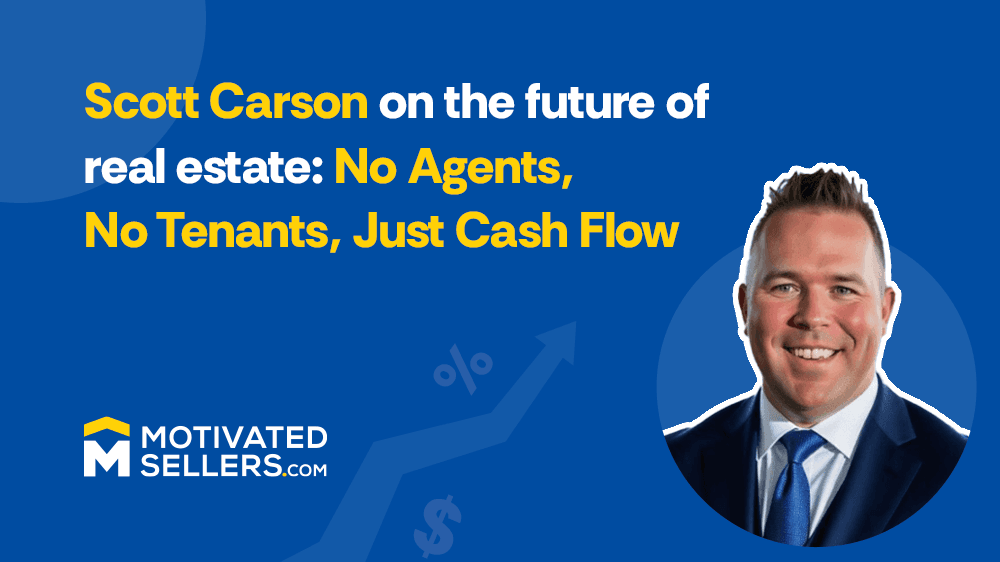
Why Smart Investors Are Buying Debt Instead of Real Estate in 2026
Most people are not familiar with mortgage note investment. Scott buys nonperforming debt from banks, hedge funds, and other lenders. He rehabilitates the borrowers to earn a double-digit ROI. Investing in notes is different from investing in physical properties. This interview explores real note investing transactions and all the details you need to start investing in distressed debt.
How Did You Get Started in the Mortgage Note Investment Industry?
Scott Carson has been active in real estate for over 20 years. He has been a wholesaler, a flipper, and a capital raiser. He was a mortgage broker when he witnessed the 2008 recession, and that changed everything. In his words:
“I went 100% full-time into buying distressed mortgages, which I had originated a few months earlier. Fast-forward to today, and we have bought almost $2 billion in distressed debt on residential and commercial properties. We have raised millions of dollars in capital.”
Scott mentions that distressed debt investing is the “sexy” side of real estate because you don’t have to deal with tenants and evictions.
Do You Have to Foreclose on Properties?
Most people think about foreclosure if you are investing in nonperforming debt, but that’s not true. When talking about his strategy, Scott mentions:
“We try to keep the borrower in their house. We want to create a way for them to start paying their mortgage again. We are successful in our attempts around 70% of the time. Sometimes you just have to foreclose because people cannot afford the house or won’t come to the table. But that’s not a guaranteed outcome in every situation.”
Why Would a Bank Sell Nonperforming Notes at a Discount to Investors?
Scott replied that he receives this question all the time.
“Banks get rid of nonperforming debt to make space for profitable deals. Every state has a different foreclosure timeline. The foreclosure happens very quickly in Texas or Georgia, but it will take forever to foreclose on a property in Florida. A bank has to carry money in reserves for every nonperforming note on its books. That’s money they cannot lend out. So in longer judicial foreclosure states, the value of that note for the bank drops 5% to 10% per month. If a borrower hasn't paid in six months, the paper isn't worth what it was written for.”
“So instead of waiting 6 to 36 months to foreclose on the property, banks can sell the note at a 40% to 50% discount. They can now lend that money out again,” Scott explains the bank philosophy of selling those loans at a discounted price.
Interesting Data: There are roughly 4,000–4,500 FDIC-insured banks in the U.S., along with thousands of nonbank lenders, mortgage companies, and private investors originating loans. Even with mortgage performance remaining strong, a small percentage of defaults across such a massive market still translates into billions in nonperforming debt that banks need to move off their books.
Creating a Win-Win Situation with Mortgage Note Investing
The best part of real estate investing is not just the capital. You get to change lives. Scott shared a heartwarming story with our listeners in the podcast.
“A woman in Southern Illinois hadn’t made a mortgage payment in 4 years. She was trying to get a loan modification. The outstanding debt was $60,000, but the little house was worth $35,000. She was struggling because her husband had a heart attack and their income had dropped. Her monthly payment for principal and interest was around $400, but she couldn’t pay that. We bought that note for $12,000.”
I called her and said, "I see you've been trying to do a loan modification for four years. Can you start making your existing payment? I know you can't bring four years of payments to the table." She said yes. I asked if she could put some skin in the game. She couldn't do $5,000, so I asked for $2,500 — and she agreed. I also asked if she could pay an extra $200 per month. She agreed to that too. Her interest rate at the time was around 12%, which was absurd.
I told her, bring a check for $2,500 to my attorney, start paying $400 plus $200 extra per month, and if you do that for a year, I'll evaluate the property and forgive any balance above what it's worth. At the end of the year, the property had appreciated to $50,000, so we forgave $10,000 of her balance. We also dropped her interest rate to 0% so she could pay the house off in six years instead of 30-plus. She paid on time for six years and paid the house off completely.
About a year into the deal, she called me, overjoyed, asked for my mailing address, and sent me a Christmas card—her, her husband, their three kids, and their newest granddaughter, whom they named Carson after me for helping them stay in their home.
It was a great deal for her and a great deal for me. I paid $12,000, made $10,000 in the first year, and collected roughly $4,800 per year for the next six years on top of that. Phenomenal ROI — and a true win-win.
Calculating the Numbers on a Real Deal from A to Z
Location: Cutler Bay, Florida
Appraised Value: $950,000
It was a non-performing debt. The borrower owed $2 million and hadn’t paid in four years. Scott bought that note for $441,000. The property couldn’t be foreclosed on for a year because of a code violation. But eventually, it was foreclosed. After investing $50,000 into the property, it was listed for $1.25 million. They received an offer at $1.1 million. In the end, it was a profitable deal yielding more than $250,000 after legal fees, renovation expenses, and holding costs.
At the time of the interview, Scott was reviewing a deal in Austin, Texas, and he shared the numbers with our viewers:
- Owed amount: $250,000
- Mortgage rate: 6%
- Purchase price for the note: Around $125,000
“We can earn a 12% cash-on-cash return if the borrower can start making payments at 6%. If a foreclosure has to happen, the property can be auctioned for 90% of the investment value. We can also list the property for $225,000 to $250,000. The whole process will take around 6 months from start to finish.”
Common Mistakes Made by Real Estate Investors
Most people make the mistake of overpaying for non-performing debt because they think about investing in a physical asset.
Let’s say a property is worth $200,000 and the borrower owes $90,000. Don’t go about bidding $130,000 when the outstanding amount is $90,000. Most people will say that’s 65% of the ARV. The ARV rule doesn’t apply to mortgage note investing.
“At 70 cents on the dollar of what’s owed, you should be paying $63,000 — not $130,000.”
Another big mistake is not verifying outstanding tax debt and the borrower’s payment history. You must review the collateral file, which includes the payment history, a copy of the original note, the mortgage, and the servicing history.
Best Markets for Investing in Nonperforming Debt
Scott actively invests in 20 to 30 states.
“Banks and lenders send me lists from all across the country. It might be a single note in Houston or a tape of 4,000 nonperforming notes spread across all 50 states that I can cherry-pick from.”
Each market offers different perks to investors. States like Texas and Georgia get a lot of buzz because of their fast foreclosure timelines. Investors in California want to buy debt in Missouri or Michigan because they can foreclose in 90 or so days. You can buy a pretty decent property outside of Detroit for $50,000, whereas in California, that’s not even buying a doghouse these days.
States like Ohio offer a lot of growth even with a long foreclosure timeline. Indiana has been big for landlords and note investors. Florida used to be a great investing state, but it has lost some of its luster with increased insurance costs, higher taxes, and market delays, especially in the condo space.
Surprising Facts About Note Investing
- You don’t need millions of dollars to buy notes from banks. We have submitted bids to a major lender after receiving a list of 47 notes with balances as low as $8,000. You can buy that note with the money sitting in your IRA.
- When buying a note, you don’t automatically end up with a property. You act like the bank, and in some situations, you might end up with an occupied asset, but that’s not always the case.
- Wholesalers can flip notes in the same way you flip properties in a wholesale deal.
How to Acquire Nonperforming Notes from Banks
Big brand banks (Chase, Citi, Wells Fargo, and Bank of America) won’t sell you a loan pool unless you can write a $50 to $100 million check. However, small regional banks, lending institutions, mortgage bankers, and non-bank lenders have assets available for purchase.
Scott mentions leveraging LinkedIn to contact bank employees with specific job titles—special asset manager, secondary marketing manager, whole loan trader, chief credit risk officer, and loan portfolio manager. Once you get on their list, the banks will typically send you offerings once a month or once a quarter. They're not asking for proof of funds upfront. As long as you talk the talk and they eventually get a wire at closing, they really don't care for the most part.
Scott has built over 30,000 followers on LinkedIn.

How Should Real Estate Investors Build a Following on Social Media?
Scott laughed while replying to this question.
“What year is it? It’s 2026, I guess. Scott mentioned, “But many people are still doing business like in ancient times.”
“I may use direct mail campaigns for raising private capital but most of our deal flow comes through social media. AI now indexes what you are posting. Without a social media presence, AI cannot recommend you.
People are searching online:
- Who is the best wholesaler in Miami?
- Who is the best flipper in Indianapolis?
Regardless of your niche, you must spread the word yourself. Start marketing now because it compounds over time. Think about McDonald's: they've sold billions and billions of hamburgers, but they still market like crazy. And you can do the same with the same tools.
LinkedIn used to allow 100 connection requests per day. Now, it’s capped at around 100 per week. We used a service called Octopus CRM to create a list of a thousand profiles and send out 50 to 100 connection requests per day to asset managers, real estate investors, and even podcast hosts. We went from 6,000 to 30,000 followers using that one tool over a few years.”
Which AI Tools and Systems Are You Using to Scale the Business?
Scott recommended many tools, including:
- Claude
- Gemini
- Canva
- Grok—helps with topics and new articles that can be shared with clients
- Delphi—I also cloned myself using an AI tool called Delphi. Now there's a 24/7, 365 days a year digital clone of me that can answer questions via phone or text at 2 or 3 in the morning—so clients can get answers to their burning questions without me having to field every call personally.
Future of the Real Estate Market Especially the Single Family Space
Scott feels that most realtors, mortgage brokers, and loan officers would be replaced by AI.
AI will guide you through the entire process: it books a phone call, you view the property, there's a virtual walkthrough, you fill out your information, and you're approved and closed—all without a human loan officer or realtor.
Real estate investors must understand that speed is everything. Make fast, well-informed decisions and leverage every available tool. Roofing companies now rarely send someone out for a bid. It's done online via AI, Google Maps, and drones. The same principle applies to rehabbing and staging properties—if you're not staging physically, you need to use AI staging tools so buyers can visualize the potential.
How Would You Restart Today with Only $10k and Your Wisdom?
Scott says he would begin by purchasing leads. He would reach out to distressed homeowners.
“I would be networking at my local real estate investor association clubs, talking to wholesalers, and talking to landlords who are exhausted from evictions and might be ready to sell.”
“80% of sales happen after the fifth contact. That doesn't mean you send one postcard and sit around waiting for the phone to ring. It means you knock on doors, post on social media, follow up via direct mail, and rinse and repeat. 90% of investors fail because they don't build follow-up systems. They drop a lot of money on marketing and then quit after one attempt.
70% of the deals we close come a month or two after we originally made our offer—because the higher bidder fell through, the seller is now motivated, and our lower offer suddenly looks very good.”
Scott’s Secret Tip for Our Investors
There are trillions of dollars in private money out there. The average self-directed IRA investor has at least $180,000 in their account with custodians like Equity Trust, Inspira, or Pensco.
You can go to the county recorder’s office, county clerk’s office, or county appraisal district and search by IRA custodian name. You type in "Equity Trust," and it will pull up a list of people who have used their Equity Trust IRA account to purchase real estate in that county. Those are real estate investors who have already done a deal, already have IRA money, and are required to invest it passively. They are pre-qualified investors.
You can reach out simply: "Hey, I saw you bought a property through your IRA. Are you looking for more deals?" A simple postcard or letter campaign to IRA investors in your area could put you 90 days away from raising a million dollars.
What’s Next for Scott Carson on a Personal and Business Level?
On a business level, Scott Carson and his team are investing in more distressed mortgage debt. They are leveraging AI to serve and educate people.
Personally, he’s looking to move closer to the Texas coast, closer to his family in South Texas. His goal is to build enough cash-flowing assets so he doesn’t have to work as hard in four or five years. Scott mentions that you have financial freedom if the cash covers your needs. It doesn’t have to be a big amount. It could be $20,000, $10,000, or $3,500 a month. Scott passionately mentioned that he wants to see another thousand investors buy their first note in the next 24 to 36 months. You can connect with Scott via his website: weclosenotes.com. He is also available on social media. You can book a call with him directly at talkwithscottcarson.com.