



In this conversation with Trevor Mauch (founder of Carrot.com), we distill a unique way to earn consistent income from real estate without experience or capital. Trevor Mauch bought his first multifamily property at twenty-one with only $600 to his name. That early experience shaped how he viewed real estate—not just as an investment vehicle, but as a business driven by systems and marketing.
As of today, his bootstrapped SaaS company has generated millions of inbound leads, ranking on the Inc. 5000 list for five years.
This interview is packed with gems. Here is a preview:
Back in 2004, I learned about wholesaling and flipping. I bought my first fourplex, which generated positive cash flow, but I wasn’t into real estate. I loved marketing more than investing. So, I decided to do something with real estate marketing while using the internet to drive leads for my business.
People use the internet for all major life decisions. It could be a medical-related search or researching home prices, but one thing is clear. Before making any crucial decision, people go online to gather information or evidence. That’s why internet marketing is important for real estate investors. There is also a differentiation factor.
Fifty years ago, you only needed a yard sign and a Yellow Pages listing to succeed. Today, a saturated market requires more effort. That shift in buyer behavior is exactly why real estate marketing moved from visibility to conversion.
My first website was built with Dreamweaver—later came WordPress, which made things easier. We started getting visitors, but they were not converting. So we began running marketing experiments and testing to improve conversions.
It was 2012, and we were pioneers in this industry, driving performance-based marketing online in this space. Our team performed more than six hundred split tests to determine:
Our page structure has been used as a template by most marketing companies in the space.
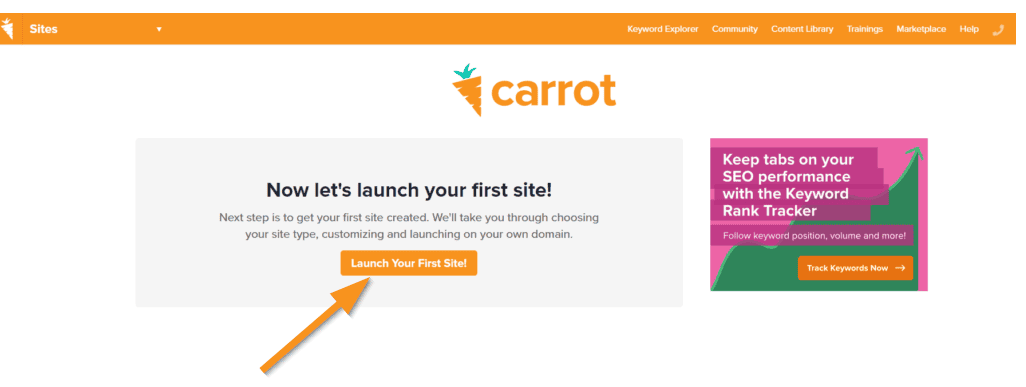
Since launching Carrot.com, we have helped thousands of investors, wholesalers, flippers, and land buyers. You can review first-page search results for any variation of this keyword:
Sell my house fast + [city]
The first three to eight results will be from Carrot websites. Our investors continue to dominate the inbound marketing space through our performance-driven marketing efforts.
Trevor wanted to have fun with the brand name. He wanted a color that nobody had used in our space, and orange wasn’t taken. He also wanted a brand name that could be expanded into other markets.
A website is an attraction. It pulls in clients. It’s like a dangling carrot—you have to make it enticing enough for people to grab it.
Trevor talked about the most common mistakes made by investors when it comes to digital marketing:
"Most investors assume they don’t need a top-performing website because they are already generating leads through direct mail or cold calling. That’s the biggest mistake in our industry."
"One of our clients, “Carter,” a well-known operator in Oklahoma, had spent $10,000 on a website that wasn’t converting. After we made a few tweaks, the website started generating an additional $20,000 per month from their existing lead flow—people who were already searching for their brand online."
The second issue is a lack of credibility. Trevor talked about this at an InvestorFuel mastermind back in 2016. Credibility is the name of the game today.
A few years ago, Google introduced the E-E-A-T framework (Experience, Expertise, Authority, and Trust). Before your website can rank, you must demonstrate real experience, showcase your expertise, and build trust with your audience through strong service or testimonials. Google wants to see that your website is a trusted resource before it sends you any traffic. That remains true today, regardless of algorithm updates.
Trevor suggests, building a website around your story.
"Make it the hub of your brand reputation. Help people, then collect testimonials from those clients and publish them on your website. That’s how you build credibility with prospective sellers".
The third biggest mistake is not giving online channels enough time to work. Investors launch a PPC campaign with a $1,500 budget and give up quickly because they only receive six leads and don’t close a single deal. In that example, the cost per lead is $250.
That’s not how the math works. You must optimize for a three-to-one or four-to-one ROI. That means if your return is $20,000, your cost per deal can be $5,000. When you stop at $1,500, you don’t give digital marketing a chance to scale. There simply isn’t enough data for the math to work.
1. Online marketing can amplify returns from your existing offline advertising efforts. Even if you are generating leads offline, a strong website can significantly boost conversions.
2. Your website should be the central hub of authority and trust. There is no other way to differentiate yourself from the crowd.
3. Set realistic expectations around your marketing budget. A four-to-one or three-to-one ROI is the benchmark you should target across all marketing channels, including your website.
Your website won’t convert if you and your designer have simply thrown together a few well-designed pages. You must pay attention to several factors, including
In our split tests, we discovered that a benefit-oriented CTA like “Get a Fair Cash Offer” outperformed “Fast Cash Offer” because everyone wants a fair offer, but not everyone needs a fast offer.
When we work with investors, we first optimize the website for speed. The target load time is 2.5 seconds. The hero section (site banner and text) should fully load within that window. There is no meaningful SEO benefit beyond the initial 2.5-second mark.
Next, we pinpoint the keywords being reinforced through offline marketing. We capture searches that originate from those offline efforts and build location pages that create a technical foundation for future PPC campaigns.
Button size, UX copy, navigation structure, and page flow—in a high-margin business like real estate, every one of these tweaks makes a measurable difference. Each small improvement compounds and directly impacts profitability.

Top investors understand that long-term growth is contingent on brand recognition, reputation, and organic rankings. Evergreen marketing is the foundation of sustainable success. The ideal strategy is to build a strong base with content marketing and then complement it with paid ads.
Organic SEO takes time. It’s like laying one brick at a time. The construction phase requires patience, but over time, it turns into a solid wall.
Always begin with strong content marketing. Here is a practical action plan:
Lather, rinse, and repeat until you have a solid website that consistently generates inbound leads for your business.
Our client, Brian, based in Dallas, Texas, was a schoolteacher without a large budget or prior experience. He was shy and wasn’t comfortable doing a high volume of cold calls. He understood that building a pipeline of inbound leads would take time, so he leaned on hamster-wheel marketing early on.
Marketing can be divided into two sections. There is evergreen marketing, which involves building a brand. And there is "hamster wheel marketing," which involves PPC, PPL, and other strategies to generate quick results.
Brian launched his website through Carrot and committed four hours per week to learning the basics of SEO. He executed what he learned, knowing those efforts would not pay off for six to twelve months.
He drove for dollars—this was before DealMachine existed. Once a week, he wrote handwritten letters to homeowners. His first deal came from one of those letters, netting him $9,000.
He reinvested all of that money into Google PPC, which generated $300,000 in revenue over the next six to eight months. He then hired someone to help accelerate his SEO efforts.
In his first year of wholesaling, he generated $600,000 in Dallas, Texas—one of the most competitive markets in the country.
This is the ideal formula for anyone looking to become an investor. Hustle to get your first deal using cold calling, door knocking, PPC, or pay-per-lead. Build a strong website as your foundation because credibility can make or break your ability to close early deals. While it’s possible to get deals without a website, once you close your first deal, funnel that capital into channels that give you more leverage.
AI search is heavily weighted right now on factors like E-E-A-T. There is only one way to build moving forward—be an expert in your niche, genuinely help others, and share your expertise online. Invest in content marketing in a way that builds authority while actually helping people.
Every industry has a retail side and a wholesale side. There are problems in every market that the retail side can’t solve. Cash buyers can help a segment of the real estate market that agents and traditional channels can’t. Continue helping people and build a strong base of reviews. AI-driven search will reward you if you are a recognized expert in your local community.
Trevor runs two podcasts for real estate investors: Evergreen Marketing Show and Entrepreneur Freedom Formula. Entrepreneurs tend to hit pain lines in threes. You’ll often see challenges emerge around the $300,000 mark, then again at $1 million, and beyond.
Listen to episodes of Entrepreneur Freedom Formula, and you’ll realize there’s nothing wrong with you or your business. What you’re experiencing is normal, and there is usually a clear solution.
The key is understanding the purpose of your business. Are you hiring your business, or has the business hired you?
A business should exist for three reasons:
Trevor says he would build a performance-oriented website with Carrot.com before creating ten to twenty strong location pages.
Trevor recommends spending four to five hours per week for three months educating yourself on SEO and the online real estate marketing landscape. Once you close your first deal, reinvest those funds back into your marketing channels to create more leverage.
We’ve been in this business for more than ten years, and we’re reinventing ourselves. We are integrating AI deeply to put our massive data set to work for our clients. We recently acquired InvestorFuse, and we’re integrating it into our platform.
Our data set is one of the largest in online marketing for motivated sellers in the industry. We believe our platform can give the average investor an edge when competing with larger players. Over the next twelve months, our focus is on becoming a truly AI-driven, data-first company.

Success in real estate starts with the right leads. At MotivatedSellers.com, we provide the quality and consistency you need to close more deals.
Motivated sellers are looking for investors like you!
Contact us at
 +1 (305) 771 1557



MotivatedSellers.com is committed to digital accessibility for individuals with disabilities. We welcome feedback and accommodation requests. If you need assistance or wish to report an issue, please contact us.
Motivated Sellers is a registered trademark of Seliger Ideas Inc. and is not affiliated with MotivatedLeads.com
Copyright © 2026 Seliger Ideas Inc. All Rights Reserved.



 Your Privacy Choices