



Most investors believe motivated sellers start their journey on Google.
They don’t.
Long before a homeowner types “sell my house fast," they’re already asking a far more important question:
“Who can I trust with this decision?”
Understanding that invisible search—the search for trust—is what separates investors who generate leads from those who consistently close deals.
You can buy leads through any platform, but we have observed that investors who don’t understand the seller psychology struggle to close more deals.
Let’s define this first. Successful investors focus on a niche that works for them. It could be:
On the surface, these appear to be distinct market segments but all of these people go through a similar journey as they choose someone to trust with the biggest transaction of their life.
It’s obvious. Before someone will do a property transaction, they must trust you. And this trust can be gained in different ways depending on the person.
An elderly homeowner may not trust a PPC ad. But they might pay attention to an investor renovating a house right in their neighborhood. They might enjoy a magazine article about a “we buy houses” company in their area. They might trust a TV commercial or an investor-oriented program.
Above all, they appreciate a friendly face-to-face meeting with the investor. They will give you the keys if they trust and like you enough.
Real estate investors must first analyze their ideal homeowner and then try to earn their trust. The trust earning mechanism will be different if you are dealing with a millennial or a baby boomer. A millennial might pay attention to your website branding, social media followers, and your track record as an investor. For an elderly citizen, the warmth of a handshake, a genuine smile, and your willingness to explain the process clearly might be more valuable than the numbers themselves.
Now the seller enters the market.
They type:
What do they see?
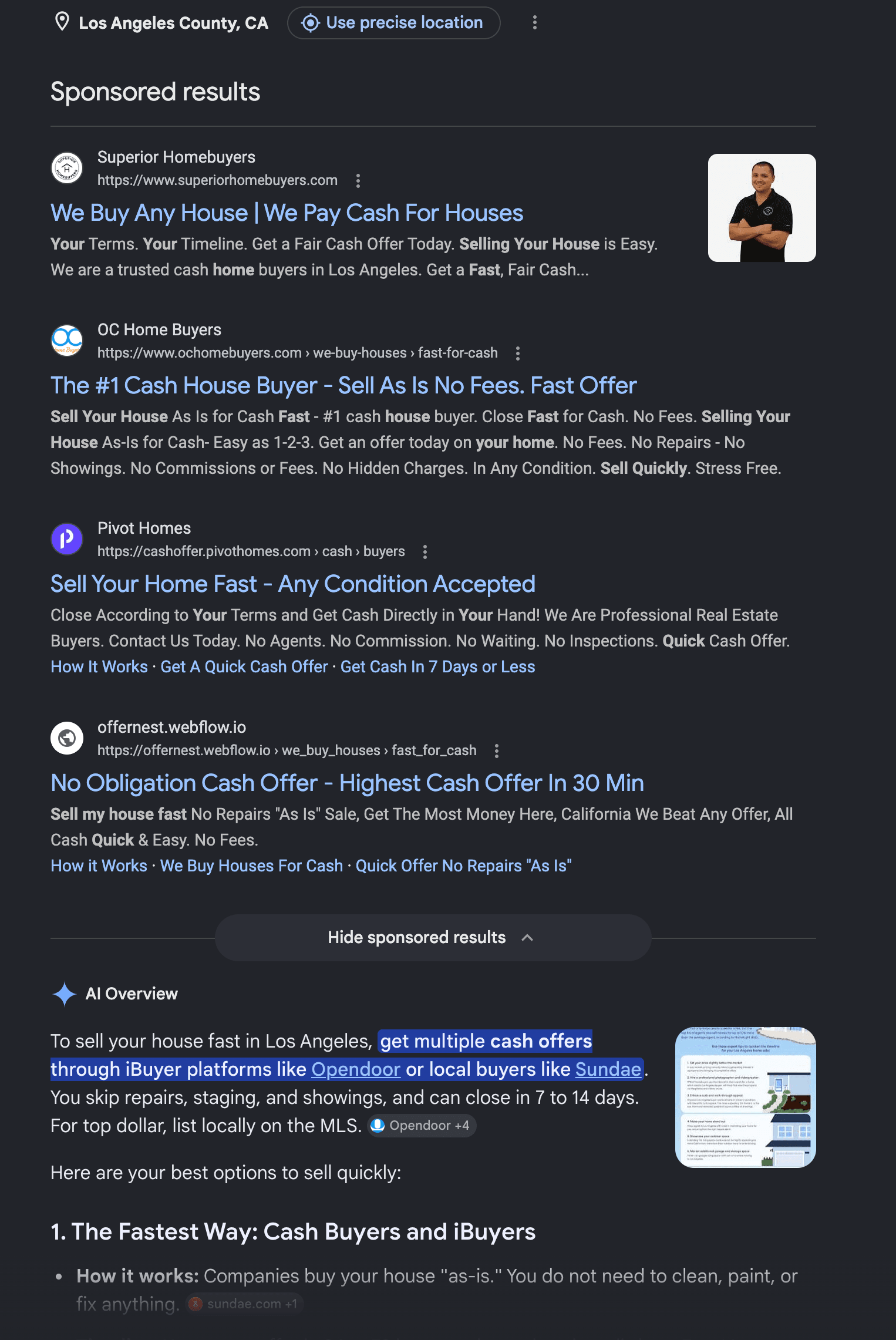
Notice something. The first four results are sponsored, but there is nothing unique about them. These results represent different cash-buying companies promising different results.
Every company mentions:
From the seller’s perspective, there is no clear differentiation.
The real estate industry has an average click-through rate of around 2.03%.
Top-position ads capture a disproportionate share of clicks—often close to 50%.
This creates two important realities:
Even if a seller clicks your ad, that doesn’t mean they believe you. It simply means you were visible at the right time.
After landing on your website, the homeowner will:
Most websites say the same things so the seller doesn’t convert immediately. Instead, they move into the comparison phase. They will go back and click on other websites to find an investor who can earn their trust.
After a few searches, the homeowner can start recognizing the following:
They are forming an idea about the “we buy houses” industry and the top players in this segment.
It’s rare to convert a lead in the first contact. It takes 5-7 touch points before someone would choose to do business with you.
When the seller leaves Google and enters other platforms and sees your advertisement on
Their immediate reaction is that “I know about this brand." This familiarity reduces the perceived risk and the seller starts trusting your company.
That’s brand presence over three different channels and the compounding effect generates results. That’s how we generate more than 20,000 motivated seller leads every month. We have a presence across all channels. There is an entire team focused on organic growth. We have PPC experts and marketing specialists who know how to help motivated sellers.

Our brains learn to trust something with repetition. We hear about a company and with enough repetition, we feel safe to communicate with that specific brand. The same is true for investors.
Every interaction contributes to one outcome: trust.
This includes:
If any one of these feels inconsistent, trust breaks.
Once all these steps lead to the final phase, you must be ready to negotiate like a best friend. Read our guide here to learn the best way to negotiate with motivated sellers, including the scripts you can follow.
People trust people. When a homeowner is facing trouble, they will not quickly start searching on Google.
Getting off-market deals is never about throwing the highest number. Motivated sellers are not looking for the top price. They are searching for a solution while facing tough circumstances. They don’t want someone to take advantage of their situation. They don’t want an unrealisticly low price.
Motivated homeowners are searching for a genuine relationship—someone who can go above and beyond to solve their particular problem. Trust is the only thing that matters in our industry. And the investors who understand that…are the ones who get the call—and the deal.

Success in real estate starts with the right leads. At MotivatedSellers.com, we provide the quality and consistency you need to close more deals.
Motivated sellers are looking for investors like you!
Contact us at
 +1 (305) 771 1557



MotivatedSellers.com is committed to digital accessibility for individuals with disabilities. We welcome feedback and accommodation requests. If you need assistance or wish to report an issue, please contact us.
Motivated Sellers is a registered trademark of Seliger Ideas Inc. and is not affiliated with MotivatedLeads.com
Copyright © 2026 Seliger Ideas Inc. All Rights Reserved.


 Your Privacy Choices