



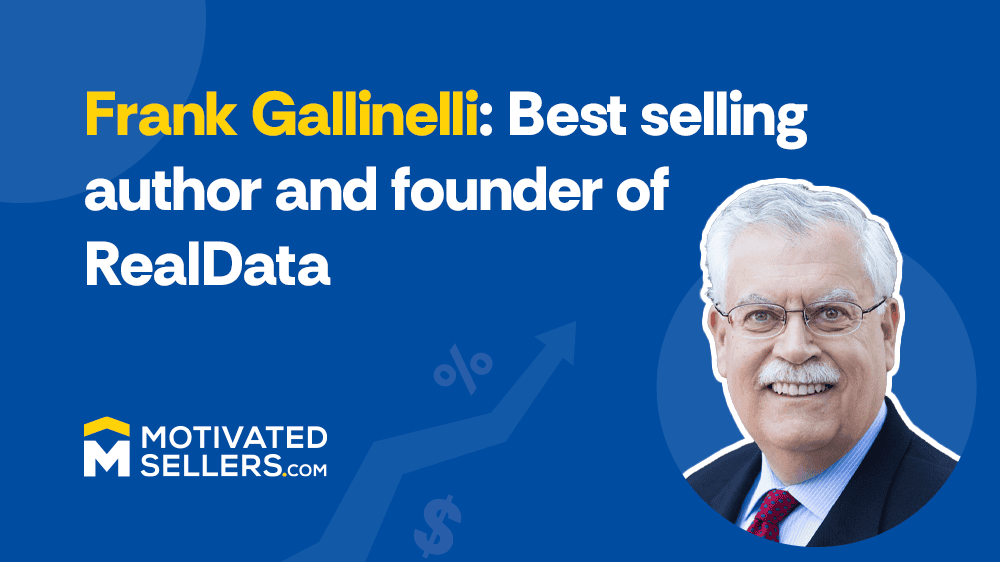
Frank Gallinelli is the founder of RealData and the author of several influential books, including What Every Real Estate Investor Needs to Know About Cash Flow. His work is a must-read if you want to lock in profitable investment deals.
The interesting part is that Frank never set out to become an educator or author. He just wanted to figure out the right price for a commercial property deal.
What happened next is a masterclass in how solving your own problem can accidentally create an entire business.
How did you go from being a real estate investor to building RealData?
It all started as an analysis model for my own use. I'm talking about the era when personal computers were just becoming available to the public. I was trying to figure out the appropriate price for a commercial property. My prior experience as a commercial sales manager at a real estate company taught me how to do analysis with paper and pencil.
Then I discovered this strange piece of equipment called a personal computer, which had something called a "spreadsheet." This was long before Excel even existed. I thought, "Let me see if I can duplicate what I did with paper and pencil on this spreadsheet thing."
So I did. I analyzed that particular property, and some colleagues saw it and requested a similar product.
I said, "Sure."
And just like that, a software company was born.
I started selling these little models. We're talking about SuperCalc back then, before it was called Multiplan by Microsoft. We were actually one of the first beta testers for Excel on the Macintosh when it finally came out—on Mac first, not Windows.
"A software company was born because colleagues wanted what I'd built for myself. I wasn't trying to start a business. I was just trying to solve my own problem."
So you're selling software. What made you pivot into education?
After a few years of selling the software, I noticed a pattern. People were calling for support, but they weren't asking the technical questions you'd expect. Instead, they were calling up with conceptual questions:
That's when it hit me.
There were thousands of people on this planet investing in real estate, and they didn't fully understand the analysis they were doing. They didn't understand the metrics or the results our software was producing.
I realized two things:
To help our customers, I started writing informative articles about real estate analysis and the key terms. That was long before the articles were called blogs. We were early adopters of the internet. Those initial articles launched my career as an educator.
Let's talk about your book, What Every Real Estate Investor Needs to Know About Cash Flow. How did that come about?
It's a funny story. I was minding my own business one day when the phone rang. An editor was calling from McGraw-Hill.
Now, I knew absolutely nothing about book publishing. I didn't realize the level of gratitude you were supposed to express when a well-known publisher calls you. I gave the guy a hard time. Eventually I agreed to send them a sample chapter, and they then agreed to publish it.
The book is now in its third edition. The publishers were originally hoping to sell 5,000 copies, but the sales exceeded expectations with a total of 180,000 copies sold so far.
I think people wanted a book without big promises of getting rich. My book showed them the math behind a successful deal in an approachable, accessible way. They just had to understand the key metrics that mattered.
The graph for a man's success rarely looks like a straight line, and Frank's teaching career proves it. His work with Columbia Graduate School and the University of Alabama happened 20 to 25 years apart, but they unfolded in almost identical ways.
A neighbor living a block away had read Frank’s articles. This person knew the director of Columbia’s Master of Science in Real Estate Development program and thought Frank’s material would be perfect for their students.
Frank started by giving a seven-hour "Real Estate Finance" lecture on the first day of classes. The school later asked him to teach a full half-semester course and he went on to teach students for 14 years.
He started with 8 students, but after 14 years, it became a required course for all students. Frank Gallinelli enjoyed the engagement with the students, but riding the metro into the city was becoming a hassle with time.
Then another opportunity arrived following the exact same pattern.
When Frank's book first came out, he received a positive review from Bill Evans, who was then the director of the Alabama Center for Real Estate. They connected online. Bill had written a dictionary of real estate terms, and Frank reviewed it. Bill's wife Denise was a CCIM involved in real estate education. The three became acquainted and stayed in loose touch over the years.
Frank was introduced to the current director of the Alabama Center for Real Estate. The director liked Frank's work and recommended his online video course, with special student pricing for all 800 real estate students at the university.
This is the success you can expect with consistent, good content marketing.
Owning a home is very different from running an investment business. If you own a property, you’ll speak about ARV, comparable sales, and mortgage rates. You are purchasing bricks, boards, and plumbing fixtures. With an investment property, you’re buying an income stream. You need to learn how to evaluate income-producing property.
Consider two identical office buildings, physically next door to each other. They were built by the same contractor and architect and have the same square footage. Everything about these buildings is identical except the leases.
One is leased at normal market rates. The other was rented for 10 yea at below-market rates.
Are these buildings worth the same to an investor?
No. Physically identical, but the income streams are completely different. Therefore, their values are completely different.
"Once you begin to internalize that way of thinking, now you're thinking like a real estate investor," Frank says.
This is why comparable sales work for homes but fail for investment properties. A home's value is determined by what similar homes sell for. An investment property's value is determined by the income it produces. It's not about the building. It's about cash flow.
After decades of teaching and working with investors, Frank has identified the single biggest mistake new investors make, and it happens before they ever look at a property.
"The biggest mistake is not stepping back and asking themselves: Why am I investing? What's my purpose? What's my goal? Depending on your answer, what you buy and on what terms can be completely different."
Long-term wealth investors consider buy-and-hold strategies focused on IRR. Appreciation and equity are the answer for building a retirement fund. Fix-and-flip or wholesaling is your game if you would like to earn quick profit. Most investors skip this step and wonder why they feel lost in their analysis.
Cash flow doesn’t matter for rehab projects. For long-term holds, the cash flow is nice, but the resale value may matter more. Your debt coverage ratio and the IRR also matter.
It’s important to have positive cash flow because a negative cash flow is basically money coming out of your pocket, but it is not the only thing to be concerned about.
Frank believes he will start with house hacking and that’s exactly what he did 40 years ago. Invest in a multifamily property, and rent out the other units to cover your mortgage, taxes, and insurance while the property appreciates over time. After that, the BRRR method can help you grow wealth over years.
Frank Gallinelli is operating RealData with the help from his team in New Hampshire. The goal is to continue creating educational content through blog posts and podcasts and help students with careers in real estate.

Success in real estate starts with the right leads. At MotivatedSellers.com, we provide the quality and consistency you need to close more deals.
Motivated sellers are looking for investors like you!
Contact us at
 +1 (305) 771 1557



MotivatedSellers.com is committed to digital accessibility for individuals with disabilities. We welcome feedback and accommodation requests. If you need assistance or wish to report an issue, please contact us.
Motivated Sellers is a registered trademark of Seliger Ideas Inc. and is not affiliated with MotivatedLeads.com
Copyright © 2026 Seliger Ideas Inc. All Rights Reserved.



 Your Privacy Choices